
The same diamond, the same certification — at the price it always should have been.
“Made for the woman who was always going to end up wearing it.”
The round brilliant is not a preference — it is a conclusion. After two centuries of diamond cutting, every shape that followed was measured against it and found wanting. Its fifty-eight facets are not arranged at random; they are calculated at angles so precise that light entering the stone has no choice but to reverse direction and return to your eye as fire. This is the cut that built the diamond industry and the one that, even today, stops rooms. Not because it is fashionable. Because it is correct.
There is a kind of beauty that does not ask permission. This one was built to be kept.
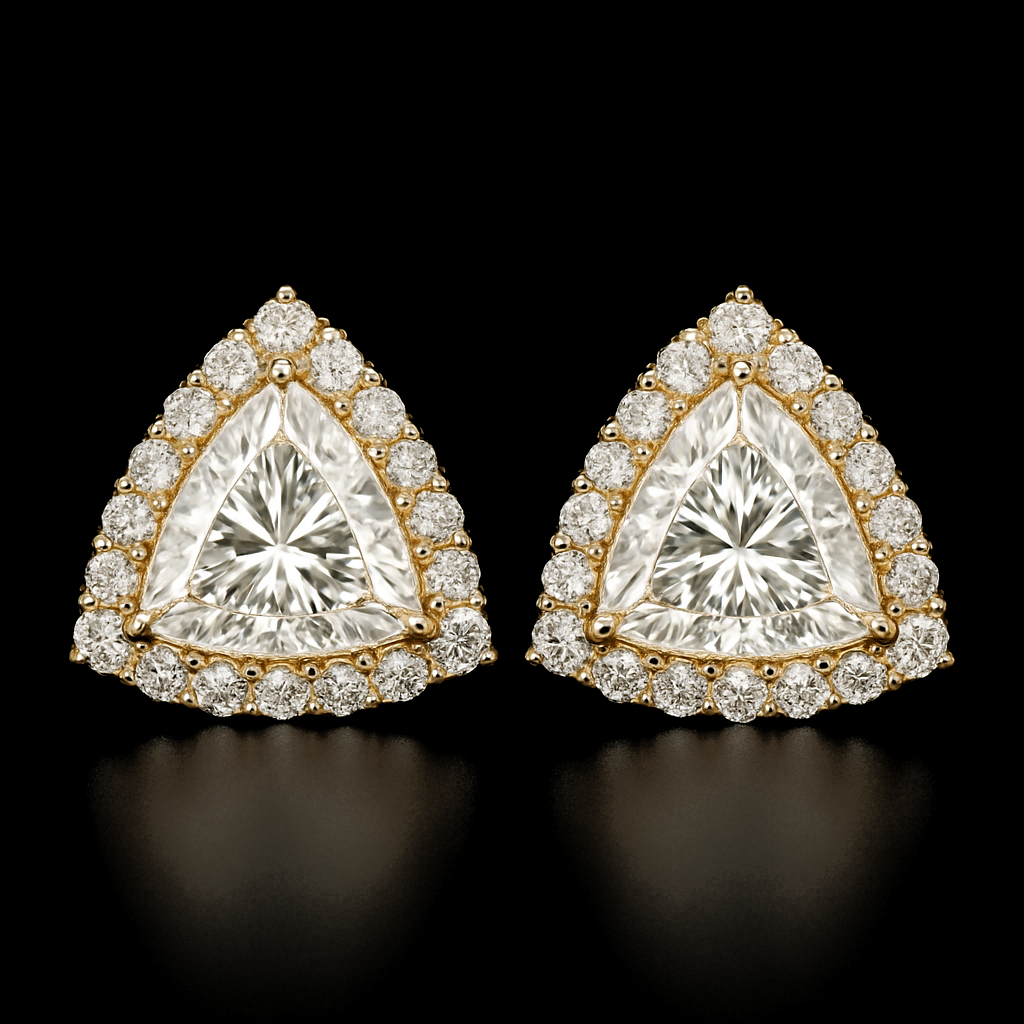
Two mirror-perfect earrings, each holding a colourless (D) trillion at its heart and drawn out in graduated brilliance to about 11.31 carats across the pair, in stud silhouette. Graded ideal in cut and excellent in polish and symmetry, it has the restless, living sparkle only precise work produces. It is set in eighteen-karat yellow gold, glowing and unapologetic, the oldest language of luxury.
A fine colourless diamond hides nothing and faults nowhere; it simply returns light whole. It is the classicist's choice — the stone that has carried the word forever through every generation that came before hers. Here it is presented in the trillion, three-sided and daring, a cut for a woman who was never going to blend in — the cut that flatters a colourless stone most honestly.
The making is where the money quietly lives. Hand-pierced galleries, hand-set accents, a shank balanced so the piece wears as beautifully as it photographs — the kind of craft you feel before you can name.
Numbers describe it. They do not explain what happens when it is worn.
Imagine it framing her face on the night that matters — the turn of a head, the half-second of silence, the friend who leans in and says nothing because there is nothing to say. Some pieces get noticed. This one gets remembered, by everyone in the room, for a very long time.
And it says something. Not loudly — this is not jewellery that shouts — but unmistakably: that she is a woman who knows the difference between what is expensive and what is rare, and chose rare. That she was never going to settle for the version everyone else already owns.
Wanting it and having it are closer than they look. It starts with a free CAD render in twenty-four hours — no deposit, no obligation, nothing to lose — and finishes on financing so gentle the only real question left is which evening she wears it first. Some things should not have to wait; they should be arranged.
There is exactly one of these, and there will only ever be one. The stone has waited a long time to become precisely this; all that remains is the hand it was meant for. Reserve it, and the rest is made easy — refuse it, and it simply becomes someone else's forever.